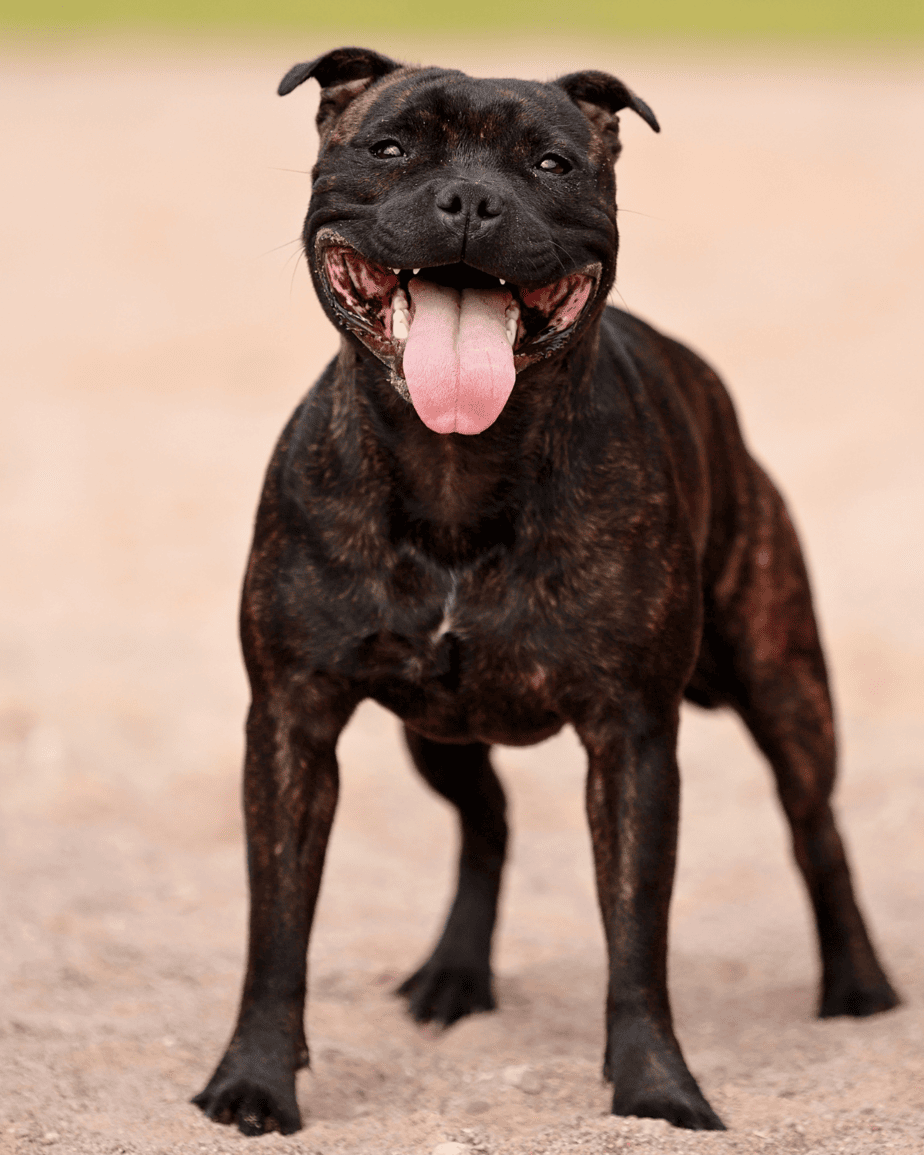
I’m Hannah, and this is my rescue pup, Tyson the Staffordshire Bull Terrier.
Further reading: related guidance from Rebarkable
As a new dog owner, I was overwhelmed by how much stuff there is out there for pups, and how much dubious advice there was from fellow dog owners and brands alike.
Thankfully, I’ve always been independent and I like exploring new things. I quickly realised that a harness would be best for Tyson, over just using his collar.
But which harness would be best for a bully breed like Tyson? It took a while, but I found the perfect option.
If you’re a new bully owner and want to learn from my mistakes and past choices, keep reading!
Why Harnesses Are Great For Bully Breeds
Look, I know a lot of people think that you should keep it as simple as possible when it comes to dog ownership, and to an extent I agree.
Still, while a collar is essential for carrying dog tags, I personally think it’s not good for using with a lead.
A little help from Rebarkable
Need a training plan—not another generic tip?
Shop my illustrated, positive-reinforcement guides for puppies, reactive dogs, enrichment and everyday training.
Browse Rebarkable GuidesPositive reinforcement · Digital download · Instant access
For dogs like Tyson, who is very reactive and pulls like an absolute train, it can be bad for their throats to be pulling against a collar.
Many bully breed dogs get reactive and pull on the lead, because of their history. Bull, or bully breeds, descend from Molosser dogs, which were used for bull baiting in Ancient Greece. Most have ‘bull’ in the name, like Staffordshire Bull Terriers, Bulldogs and others, but some dogs like Boxers, Boston Terriers and several types of Mastiff are also bull breeds.
All these dogs have common traits: a broad chest and a curious disposition. Many bull breeds struggle with reactivity, especially around other dogs- I know that firsthand from living with Tyson. Staffordshire Bull Terriers are among the most common dogs seen in shelters, so they often suffer from of a lot of trust and behavioural issues, which can make them hard to deal with on the lead too.
So, keeping them safe and secure on a lead, and avoid breaking your own arm, you need to find something to safely keep them close and spread the power across their bodies, to diffuse it so it doesn’t hurt either of you.
That’s where harnesses come in. They can spread the power and help you and your dog to feel more comfortable when walking. They’re not for every breed or owner, but I personally love them for my bully breed.
Harnesses, especially the ones that go across the chest, can also be great for brachycephallic breeds too. Some bully breeds, like Frenchies and Boxers, have squashed faces which make them brachycephallic, so it’s worth seeing if you can find them the right harness to take the pressure off their throats.
For Tyson, I found it tough to get the right harness because I’ve never owned my own dog, and also so many of them advertise great no-pulling prowess that they just don’t offer!
The Harnesses We Tried
While I have looked after my family’s dogs, I’ve never owned one myself. My family are very much of the belief that you don’t need a lot for a dog, and mostly had collars for their dogs.
While I do agree that you don’t really need rain hats, coats or booties for most dogs- unless medically necessary- I think a good harness is better for the majority, as mentioned above.
With limited experience of buying a harness for any dog, never mind a staffie, I had to do a bit of trial and error. I bought a few options, mostly on the more affordable side, so I could find the right one.
From just back clips to double clips, so-called ‘tactical’ harness to small ones that just look like a few little strips, there are so many options out there. I searched Amazon, and found a few options to try out.
It took me a couple of passes to find a harness I love for Tyson. From my favourites to the ones I hardly ever use and just keep as spares, to the one I don’t own anymore, here are all the harnesses I tried out for my staffie.
The Helee Neck Connect Harness
For those who don’t want to read to the end, here’s my top pick: The Helee Neck Connect Harness.
I love this little harness as it’s really easy to use- unlike others, it doesn’t go over the dog’s head, but has a neck clip as well as two back clips.
It’s surprisingly easy to put on, even though it has got more clips than most, which I like. Many of the Amazon reviews of these harnesses said that the sizing was a bit off, but I personally found it perfect, but if you’re planning on getting a Helee harness you might want to make sure you measure your pup.
Helee offers this harness with or without the neck clip, but the neck clip version is great for dogs that don’t like having their harnesses shoved over their heads. The Helee harness also comes with a wide range of colours and designs, including ones with flowers on them that look super cute! That’s not the most important thing, I know, but it’s a nice option to have. I got the red one for my dog, because I thought it would go well with his beautiful brindle coat.
In all, I really like this comfortable harness- it has a small, simple design that’s cute and isn’t too heavy for Tyson. It’s not as customisable as other options out there, which can have extra patches or bags on them, but it’s still a nice design that is comfortable for me and the my pup.
Pros
- Chest plate to spread the pulling power
- Padded handle for control
- Reflective strips
- Reinforced back and front clip to keep your pup secure
- Neck clip means the harness is easy to fit
- The sizing is great
- A wide range of colours and designs to choose from
Cons
- Less customisable than other options
- Clips aren’t lockable so might be easy for really eager escape artists
Supet Anti-pull Dog Harness
The first front pull harness I found, I liked the simple design of this harness and the fact that it came with a lead.
The lead I love, and still use with my Helee harness. From the moment I put the Supet harness on Tyson, I knew I loved the front clip and really wanted to try it out to train him and help him improve his walking.
The issue I have with this harness, and the reason I no longer use it, is the sizing is complete nonsense.
Tyson’s chest is 64 cm, but the sizes for the harness were small, for medium dogs, which was 50-60 cm, or medium for medium dogs, which is 65-75cm.
As recommended by the manufacturer, I went for the bigger size, as he’s only 1cm off 65cm. However, as you can see, the harness swamps him.
There’s simply no way that this is 65cm, when Tyson is only 64 in the chest and it’s literally inches too big. It slips everywhere and doesn’t fit him at all.
The only reason I didn’t return it that, frankly, I’m lazy, and the returns processes isn’t easy for this product. I love the lead, and still use it, so I at least get some use out of part of it. It’s strong and has a rubber band round the loop, so it’s comfy on my arm. Also, it wasn’t expensive, so I’ll either donate it to a shelter or keep it for a future dog who’s bigger than 65cm in the chest!
Pros
- Strong harness with chest padding to keep your pet comfortable
- Front and back clips give you options
- Reflective straps make it easy to spot at night
- The handle goes from front-to-back, not side-to-side, making it ideal for lifting dogs out of water as you won’t tip them forward
- Comes with a really strong, comfortable lead
- Lockable straps make it great for the car or escape-artist dogs
Cons
- Sizing is completely incorrect
- The harnesses aren’t suitable for smaller breeds- even the smallest stated size is for medium dogs
- Limited colour options might put some people off
- Harness goes over the head and can be uncomfortable for some dogs
Musonic No Pull Dog Harness
One of the most basic harness I grabbed, which was less than a tenner when I bought it and came with a lead, the Musonic No Pull Harness has a lot going for it, but it’s far from perfect.
I still use this harness as a spare if the Helee is wet or dirty, because it’s a small, simple harness that does quite a bit to help stop the pulling.
It’s a very simple design, and it only has a back clip, which is the main issue I have with it. I love the front clip harnesses I’ve used, so it’s a shame there isn’t one here.
Also, the Musonic has a single strap across the front, which means it doesn’t dissipate the pressure when Tyson pulls. Still, unlike the other Norwegian harness, it does seem to help stop the pulling, as the strap sits quite low on the chest.
For the cost, though, I think is a useful little harness. It’s great for taking on trips too, as it’s so incredibly compact.
Pros
- Small, compact harness that helps stop pulling
- Easy to put on with two small clips so it doesn’t go over the head
- Reflective straps
- Handy handle on the back
- Comes in a selection of colours
- True to size
- Has a lead thrown in as standard
- Lockable straps keep your dog safe
Cons
- No front clip option
- Harness has a single strap across the front so it doesn’t spread the power as well as other options
- Handle is flimsy
- Clip is quite far back: this works well for a stocky bully breed like mine, but it might not be great for longer dogs
The Julius K9 IDC Powerharness
This was the harness Tyson came with when I bought him home. I think the rescue get a lot of them donated, because they have a load of them that get used by all the dogs there and you can take one when you foster.
This type of harness, known as a Norwegian Harness, reminds me of the sort of tool people use when getting their dogs to pull sleds. Instead of stopping pulling, it makes it easier for Tyson, with his big broad chest, to pull and drag me along.
Even though I tried to keep the harness strap low on his chest, when Tyson pulled heavily, I could hear him wheezing. He just kept barrelling forwards, with no restriction from the harness. There’s only a back clip, and so I didn’t have flexibility to pick how I controlled the dog. With the back clip, it felt like Tyson was straining against the harness, and the front strap meant he had more power to pull me around.
While it didn’t stop his pulling, what the Julius K9 did do, as many people said to me, was made him look bigger and more threatening. Because the harness was so big and almost tactical in appearance, it made him seem chunkier. For a staffie, a breed with an undeserved bad rep, who has reactivity and acts scary when he’s frightened himself, I wanted a harness that didn’t make him look too big and threatening to others.
In the end, I returned this harness because it was so heavy and it didn’t do anything to restrict Tyson’s pulling. I did like the big handle, which felt really sturdy, but I didn’t like the harness generally and I know that the RSPCA like the harness, so I gave it back to help other rescue pups.
Pros
- Big handle on the harness
- Reflective straps
- Lots of colour options
- Loads of patches available to customise your harness
Cons
- Front strap made Tyson wheeze
- The most expensive option on the list
- It felt like the harness made pulling easier for Tyson
- I had limited control on side-to-side movements
- Single back ring without front clip option
- Heavy harness made dog look bulky
The Main Features To Look For In A Harness
When you’re looking for a harness, for any breed of dog, you need to make sure you pick the right option for you that meets as many of your needs as possible.
If you search for a harness on Amazon, Google Shopping or just about any online marketplace, you’ll find literally thousands of products from different brands and in various styles.
Each one makes outlandish claims, some of which are true but many of which don’t work out for many dogs.
With prices ranging from around a tenner to over a hundred pounds, it’s important that you look for a harness with all the right features, such as:
- Clips: Most harnesses come with a d-ring on the back, but some also have a front clip to make it easier for you to train your dog on how to walk properly
- Front Padding: The front of the harness is where the pressure is, so look for the right type of harness for your dog. Norwegian harnesses have just the one strap, while Y or H-shaped harnesses have padding across the front to make your pet more comfortable as they walk
- Reflective Strips: These are useful for when your dog is out at night and needs to be seen
- Handles: Handles can be useful for when you need to hold your dog back, move them out of harm’s way or get them out of water
- Clips: The number and placement of the clips on the harness will affect how easy it is to get on your dog. Also, some harnesses have lockable clips that can be great for dogs that like to wriggle out of harnesses or knock the straps open when on the move
- Velcro Strips: Velcro strips can be useful for adding patches, which is good if you use your dog as a service or assistance animal. You can also add little bags that can be used to carry poo bags and other useful items
- Care Instructions: Most harnesses are hand wash only, but some can be thrown in the washing machine, so check how you can clean it
A Final Word On Why A Good Harness Is So Important
At the end of the day, everyone and their dog is unique, and your needs will be to mine and Tyson’s. All I can hope for is that you can see what I loved for in a harness and how I figured out the best option for me.
Hopefully, you can find a perfect harness. The right harness is comfortable for your dog and makes walking easier for you as well. It needs to fit properly, and not be too expensive, as it’ll eventually need replacing and you don’t want to have to fret about the cost.
With a little digging and a lot of review-reading, you’ll be able to find the right harness for your bully breed dog. Many bull breeds need a lot of control on walks, but reactivity and a strong pull, so might benefit from a harness over a collar.
When you do buy a harness for your dog, make sure you read the return policy and keep the packaging. Use it a few times, and if you’re not happy, contact customer service to get a better fit or a refund.
In time, you’ll be able to enjoy comfortable, safe walks with your dog. Tyson and I are loving his Helee harness, and he’s doing better by the day, though there’s still a lot to work through!
Originally published by Rebarkable.